The 2026 Italian Citizenship Shake-Up: Who Still Qualifies for the Italian Passport — and What to Do If You Don't
Italy's Constitutional Court has now upheld the most dramatic restriction of citizenship-by-descent rights in modern Italian history. Here's what actually changed, who still qualifies, and the legitimate alternative pathways nobody's talking about loudly enough.
If you've been counting on an Italian passport through your great-grandparents, the last thirteen months have been brutal. In March 2025, Foreign Minister Antonio Tajani's emergency decree slammed the door on generations of jure sanguinis applicants overnight. A year later, on March 12, 2026, the Constitutional Court confirmed it: the new restrictions are here to stay.
For millions of Italian-Americans, Italian-Argentinians, Italian-Brazilians, and Italian-Australians who had been quietly assembling birth certificates and waiting for a consulate appointment, the door didn't just narrow. For most, it closed.
But the full story is more complicated — and, in some places, more hopeful — than the headlines suggest. This post breaks down exactly what changed, who still qualifies under the new rules, and the legitimate alternative paths to Italian residency and citizenship that the reform actually opened up.

What Actually Changed: The Tajani Decree in Plain English
Before March 2025, Italian citizenship by descent had no generational limit. If you could trace an unbroken line back to an Italian ancestor born after the unification of Italy on March 17, 1861 — and prove that ancestor never naturalized in another country before passing citizenship to the next generation — you were, legally speaking, already an Italian citizen. You just needed Italy to acknowledge it.
That's gone.
Decree-Law 36/2025, converted into Law 74/2025 and now widely known as the Tajani Decree, introduces a hard two-generation cap. To qualify automatically for Italian citizenship by descent under the new rules, you must have:
A parent or grandparent born in Italy, AND
That parent or grandparent must have held exclusively Italian citizenship at the time of your birth — or at the time of their own death, whichever came first.
Great-grandparents and earlier ancestors no longer count for automatic recognition. The "1861 line" — the founding principle of jure sanguinis for over 160 years — is no longer the basis of the system.
There are narrow expansions of qualification too. You may also still qualify if your parent was born in Italy and resided there for at least two consecutive years before your birth, even if they later naturalized elsewhere.
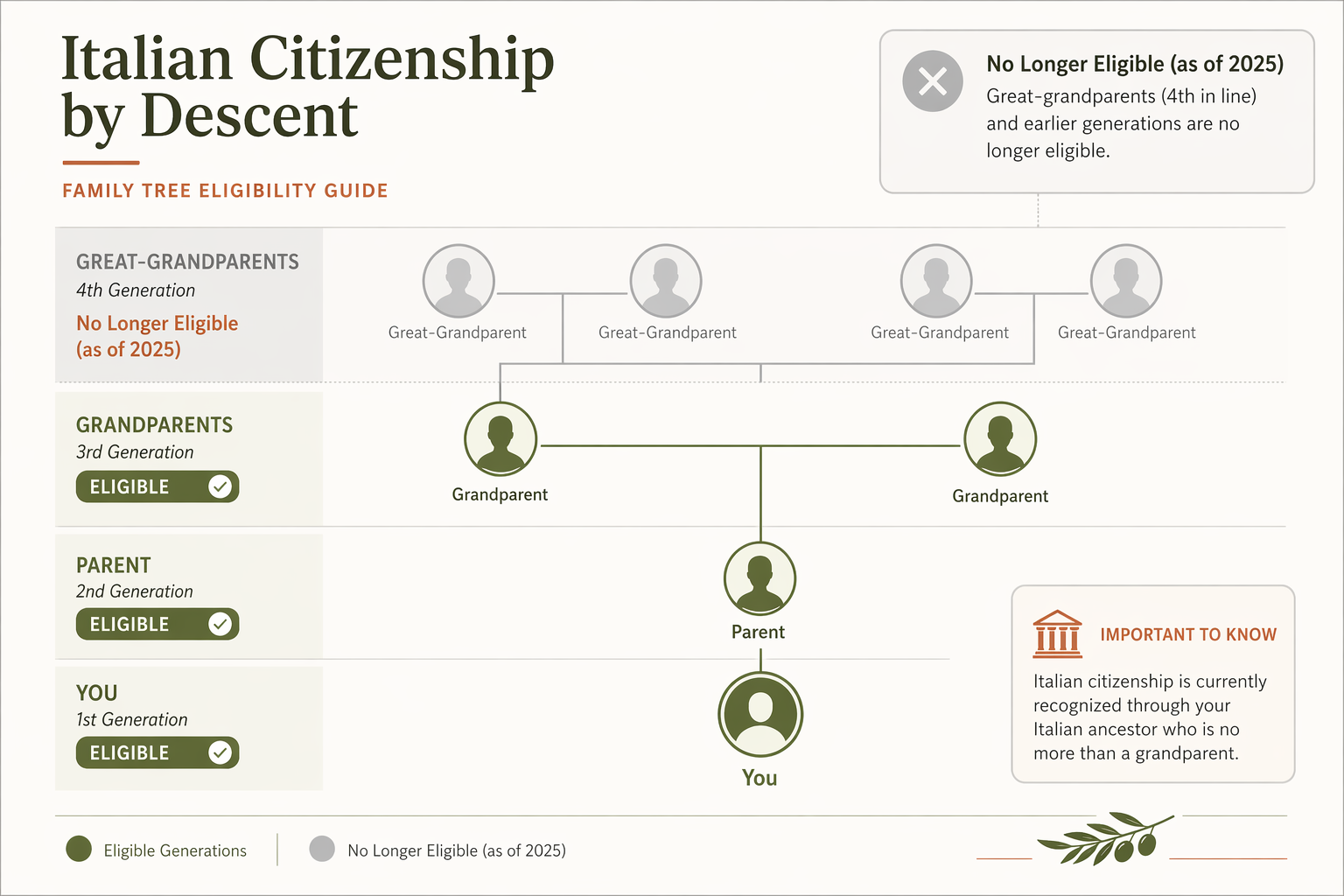
Under Law 74/2025, eligibility is limited to two ancestor generations: parent or grandparent.
The Constitutional Court Ruling: What March 12, 2026 Means
When the Tajani Decree first dropped, almost everyone affected assumed it would be struck down. Italian citizenship by descent had been treated by Italian courts for decades as a pre-existing status — something you either had at birth or didn't, that the state simply confirmed through paperwork. Stripping it away by decree felt, to many constitutional scholars, like a clear overreach.
The Court of Turin agreed and referred the question to the Constitutional Court. The hearing was held on March 11, 2026 — three hours of arguments. The decision came down a day later.
The Constitutional Court rejected the challenges, partly as inadmissible and partly as unfounded. The two-generation limit stands. The decree is constitutional. Italian citizenship by descent, as we knew it, is over.
A few important nuances:
The Turin challenge was rejected, but three additional constitutional questions raised by the courts of Mantua and Campobasso are still pending. The legal debate isn't fully exhausted.
The Corte di Cassazione (Italy's Supreme Court) is scheduled to address the question of retroactivity on April 11, 2026 — specifically, whether the decree can be applied to people born before its enactment.
A separate Sezioni Unite hearing on the so-called "minor issue" — whether an ancestor naturalizing while their child was a minor severs the chain — is scheduled for April 14, 2026.
The practical takeaway: the broad framework is now constitutionally settled. The fights remaining are about edge cases and timing, not about whether the reform stands. If you've been waiting to see whether the decree would survive — it survived.

Who Was Protected: The March 27, 2025 Cutoff
Not everyone got swept up in the reform. There's a hard cutoff baked into the law that protected applications already in the pipeline.
If by 11:59 PM Rome time on March 27, 2025 you had:
Formally submitted an application at a consulate or Italian municipality, OR
Received a confirmed consular appointment communicated to you by the competent authority, OR
Filed a court case in Italy through a 1948 lawsuit or judicial recognition path
— then your case continues to be evaluated under the pre-reform rules, which permit unlimited generational descent.
If you missed the cutoff, you're being evaluated under the new two-generation system, regardless of when you started your research, gathered your documents, or paid your translator.
This is where most of the heartbreak lives. People who spent years and thousands of dollars assembling apostilled birth certificates from three countries, only to schedule their consular appointment two weeks too late, are now ineligible. There is no grandfathering for "I was working on it." The clock was hard.
The Three Realistic Alternatives Most People Don't Know About
The headlines focused on the door that closed. The reform also quietly opened — or expanded — three doors that are worth knowing about.
1. Reduced Residency Naturalization (Two Years Instead of Ten)
This is the most underdiscussed change in the reform.
If you have an Italian parent or grandparent but no longer qualify under the new jure sanguinis rules, you can now naturalize as an Italian citizen after just two years of legal residency in Italy — instead of the standard ten years required of other foreign nationals.
In practical terms: move to Italy on a long-term residence visa (the Elective Residency visa for retirees, or the Digital Nomad Visa for remote workers, or a work visa for the employed). Live there legally for two years. Then apply for citizenship through the concessionary naturalization track.

This isn't a free pass — you still have to qualify for a visa, secure housing, register as a fiscal resident, learn enough Italian to pass a B1 language exam, and complete the application process. But the timeline drops from a decade to two years, which is genuinely transformative.
2. The Reacquisition Window for Former Citizens
If you were once an Italian citizen — born in Italy, or having lived there for at least two consecutive years — and you lost your Italian citizenship before August 16, 1992 (typically by naturalizing in another country before dual citizenship became permitted), Law 74/2025 created a special reacquisition window.
Between July 1, 2025 and December 31, 2027, you can reacquire Italian citizenship by simply submitting a declaration in person at your local Italian consulate. No residency requirement in Italy. No language test. No long wait.
Citizenship is reactivated the day after you make the declaration. The window closes at the end of 2027 — there's currently no indication it will be extended.
If this describes a parent or grandparent in your family, this could indirectly help your own situation: a newly Italian parent or grandparent doesn't automatically pass citizenship to adult descendants under the new law, but it can simplify some other pathways, including future minor-child registrations.
3. The Digital Nomad Visa (Officially Launched in 2026)
For remote workers under 65, Italy's long-promised Digital Nomad Visa finally rolled out in early 2026 with much clearer guidance than its 2024 predecessor. Current parameters:
Minimum income: €28,000/year
Skill requirement: Post-secondary degree OR three years of equivalent professional experience
Health insurance: Covering at least €30,000 in care
Accommodation: A registered Italian lease or property deed required at application (not just a "plan")
Initial duration: 1 year, renewable for up to 2 additional years
Family inclusion: Spouses and dependent children can be included on a single application

If you can hold this visa for two years and you also have an Italian parent or grandparent, you can pair it with the reduced naturalization track described above. Even without Italian ancestry, it's a legitimate route to long-term residency that wasn't reliably available eighteen months ago.
The 1948 Lawsuit Path: Mostly Closed, but Not Entirely
For years, the "1948 case" was the workaround for descendants whose Italian citizenship would have passed through a female ancestor before women could legally transmit citizenship in Italy (which was only formally recognized after a 1948 Constitutional Court decision). These cases were filed directly with the Italian courts in Rome and bypassed the consular backlog entirely.
Under the Tajani Decree, the same two-generation cap applies to judicial recognition. A new 1948 case filed today is governed by the same restrictions as a consular application. The pathway still exists — and is sometimes still useful — but it is no longer the back door it once was.
If your case was already filed before March 27, 2025, it continues under the old rules. If you're considering filing a new 1948 lawsuit, talk to a qualified Italian attorney about whether your specific facts still support a claim.
A Decision Tree: What Should You Actually Do?
Let's get practical. Here's a simplified version of how to think about your situation.
Your Situation Your Best Path Italian parent born in Italy, application submitted before 3/27/2025 Continue under pre-reform rules. You qualify. Italian parent born in Italy, application not yet filed Likely still qualify. File ASAP under the new two-gen rule. Italian grandparent born in Italy, exclusively Italian at your birth You qualify under the new two-gen rule. Italian grandparent born in Italy, naturalized before your birth You likely no longer qualify automatically. Consider 2-year naturalization. Italian great-grandparent only You no longer qualify by descent. Consider naturalization or other visas. Parent/grandparent born in Italy, lost Italian citizenship before 8/16/1992 They can reacquire by declaration before 12/31/2027. No Italian ancestry, want to relocate Digital Nomad, Elective Residency, or Investor Visa pathways.
This is a starting point, not legal advice. The new rules have a lot of nuance, especially around "exclusive citizenship" status and how naturalization timing affected lineage. If your case is anywhere close to the edge, consult a qualified Italian attorney before spending money on document gathering.
What This Means If You're Planning the Move
For most of our readers — Americans, Brits, Canadians, and Australians who'd been quietly hoping the Italian passport would smooth the path — the reform is a real loss. The passport mattered. It meant freedom of movement across the EU. It meant the right to work anywhere. It meant a backstop for adult children. For many families it was the dream version of "moving to Italy."
But here's the harder, more useful truth: citizenship was never the only thing that made the move possible. Tens of thousands of foreign retirees and remote workers live full, legal, deeply rooted lives in Italy without holding Italian passports. They're on Elective Residency visas, on Digital Nomad visas, on long-term EU permits. They have the Italian healthcare card. They pay Italian taxes. They have local doctors and favorite bakeries and church bells they recognize on the wind.
The reform has reshuffled who qualifies for the easiest path. It hasn't closed the country.
If you're reconsidering your plans, the honest framing is this: the logistics of moving to Italy got slightly more complex for a specific subset of people. The possibility of moving to Italy did not change.
The Bottom Line
The 2025–2026 reform is the most significant change to Italian citizenship law in decades, and the Constitutional Court's March 2026 ruling has settled the core question: it's here to stay. If you have a parent or grandparent born in Italy who held exclusively Italian citizenship at the right moment, you still qualify. If you don't, your jure sanguinis options are mostly gone.
But the reform also opened genuine alternatives: a two-year naturalization track for descendants who fall outside the new descent rules, a clean reacquisition window for former Italian citizens through 2027, and a finally-functional Digital Nomad Visa for remote workers.
If your great-grandfather was born in Naples in 1898, you have a harder road than you did eighteen months ago. But "harder" is not "impossible." And for many people, the path that requires actually living in Italy for two years before becoming Italian is, in its own way, the more meaningful version of the journey.

Want to dig deeper? Read our full guide to the Elective Residency Visa and our breakdown of the 7% pension tax regime for southern Italian municipalities — both of which become more strategically important under the new citizenship landscape.
Sources consulted for this post:
Italy ruling tells millions with Italian roots they have lost the right to citizenship — CNN
Italy's Constitutional Court Upholds Caps on Citizenship by Descent — IMI Daily
Constitutional Court 2026: citizenship limits confirmed — Bocca di Trezza
Italian Citizenship by Descent After March 2026 — ILF Law Firm
Reacquire Italian Citizenship: 2025–2027 Legal Guide — Bocca di Trezza
Citizenship by Descent (New Rules) — Consolato d'Italia Brisbane
A-Z Guide to the 2025 Changes to Italian Citizenship by Descent — Italian Citizenship Assistanc